How Both Teams Score Works In Football Betting

Want expert predictions delivered daily?
Get free tips on Telegram or upgrade to Premium.
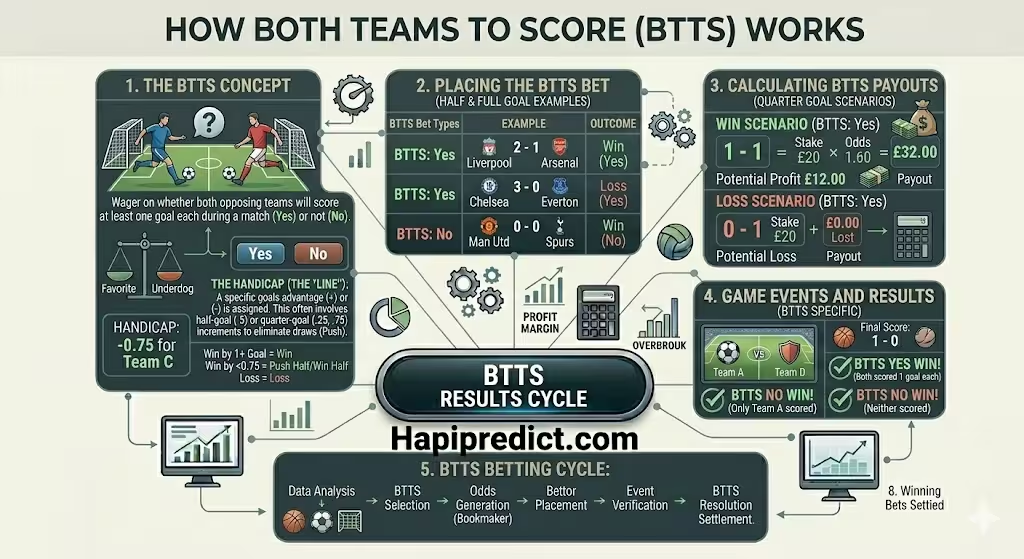
Both Teams To Score means each team must score at least one goal for the selection to win.
It is one of the most popular football betting markets because it focuses on goals from both sides, not the final winner of the match.
Both Teams To Score is often written as BTTS. The market is simple on the surface, but it still needs careful reading. A match can have many goals and still fail BTTS if only one team scores. A match can also have only two goals and still win BTTS if both sides score once.
What Is Both Teams To Score?
Both Teams To Score is a football betting market where both teams must score at least one goal.
If both sides score during the match, BTTS Yes wins. If one team fails to score, BTTS No wins.
The final score does not need to be level. One team can win, draw, or lose. The only thing that matters for BTTS Yes is whether both teams score.
For example, a 1-1 draw wins BTTS Yes because both teams scored. A 2-1 result also wins BTTS Yes because both teams scored. But a 3-0 result loses BTTS Yes because only one team scored.
This market is popular because it does not ask you to pick the winner. Instead, it asks whether the match has scoring action from both sides. That makes it useful for matches where both teams attack well but may also have defensive weaknesses.
How Does Both Teams To Score Work?
Both Teams To Score works by checking whether each team scores at least one goal before the match ends.
If both teams score, BTTS Yes wins. If one or both teams do not score, BTTS No wins.
The market is usually settled based on normal full-time result, including added time. Extra time does not usually count unless the bookmaker clearly says so in the market rules.
BTTS Yes wins with scores such as:
1-1
2-1
1-2
3-1
3-2
4-2
BTTS Yes loses with scores such as:
0-0
1-0
2-0
3-0
0-1
0-4
For example, if Manchester City beats Liverpool 3-1, BTTS Yes wins because both teams scored. If Manchester City wins 3-0, BTTS Yes loses because Liverpool did not score.
The result of the match is not the main issue. The scoring of both teams is the condition.
What Does BTTS Yes Mean?
BTTS Yes means you expect both teams to score at least once.
The match can finish with any scoreline as long as both sides get on the scoresheet.
BTTS Yes is often used when both teams have attacking quality, both teams concede often, or the match is expected to be open. It can also be considered when both teams need points and are likely to attack.
For example, if Team A and Team B both score regularly but also concede goals, BTTS Yes may look more logical than trying to pick the winner. A 1-1, 2-1, 1-2, or 2-2 scoreline would all make BTTS Yes win.
However, BTTS Yes is not guaranteed just because both teams are strong. A strong team can dominate the match and keep a clean sheet. A weaker team can fail to create good chances. This is why team style and match context matter.
What Does BTTS No Mean?
BTTS No means you expect at least one team not to score.
It wins if the match ends with one team keeping a clean sheet or if both teams fail to score.
BTTS No wins with scorelines such as:
0-0
1-0
2-0
0-1
0-2
3-0
BTTS No is often considered when one team has a strong defense, one team struggles to score, or the match is expected to be tight. It can also make sense when a favorite is likely to control the game and stop the opponent from creating clear chances.
For example, if a top team plays at home against a weak attacking side, BTTS No may be priced lower because the weaker team may struggle to score.
The risk is that one unexpected goal can change everything. A penalty, defensive mistake, red card, or set piece can make BTTS No lose even if the match was mostly controlled by one side.
What Is The Difference Between BTTS And Over 2.5 Goals?
BTTS focuses on whether both teams score, while Over 2.5 goals focuses on the total number of goals.
They are connected markets, but they do not mean the same thing.
Over 2.5 goals needs at least three total goals. BTTS Yes needs both teams to score at least once.
Examples:
2-1, BTTS Yes wins and Over 2.5 wins
1-1, BTTS Yes wins but Over 2.5 loses
3-0, Over 2.5 wins but BTTS Yes loses
0-0, both BTTS Yes and Over 2.5 lose
This difference is very important because many beginners confuse both markets. A match can be high-scoring without both teams scoring. A match can also have both teams score but still finish under 2.5 goals.
If you expect both teams to score but the match may stay tight, BTTS Yes may fit the idea better than Over 2.5 goals. If you expect one team to score many goals alone, Over 2.5 goals may fit better than BTTS Yes.
How Do Both Teams To Score Odds Work?
Both Teams To Score odds show the possible return and the implied chance of both teams scoring.
Lower odds usually mean the bookmaker sees BTTS as more likely, while higher odds suggest more risk.
A BTTS market may look like this:
Both Teams To Score Yes: 1.80
Both Teams To Score No: 1.95
This means BTTS Yes is slightly lower, so the market may see both teams scoring as a little more likely than one side failing to score.
In decimal odds, the payout formula is:
Stake × Odds = Total Return
For example:
Stake: ₦1,000
BTTS Yes odds: 1.80
₦1,000 × 1.80 = ₦1,800 total return
Profit:
₦1,800 minus ₦1,000 = ₦800
The odds are only the price. They do not guarantee that both teams will score. They should be read together with team form, attacking quality, defensive records, and match motivation.
How Do Bookmakers Set BTTS Odds?
Bookmakers set BTTS odds by estimating the chance that both teams will score in the match.
They study attacking form, defensive weakness, clean sheet records, player availability, tactics, and market activity.
For football, bookmakers may consider:
How often each team scores
How often each team concedes
Home and away scoring form
Clean sheet records
Injuries to attackers
Injuries to defenders
Match importance
Tactical style
Recent goal patterns
Strength of opposition
Public betting activity
If both teams score regularly and also concede often, BTTS Yes may be priced lower. If one team has a strong defense and the other struggles to score, BTTS No may be priced lower.
Bookmakers also add margin to the odds. This means the odds are not pure probability. They include business risk, market demand, and the bookmaker’s edge.
How Do You Analyze Both Teams To Score?
You analyze BTTS by checking whether both teams have realistic scoring chances and whether both defenses can be broken.
The best BTTS analysis looks at both attack and defense, not only recent scores.
Useful checks include:
Do both teams score regularly?
Do both teams concede regularly?
Are key attackers available?
Are important defenders missing?
Does either team keep many clean sheets?
Are both teams motivated to attack?
Is the match likely to be open or cautious?
Does the away team score well away from home?
Does the home team usually concede at home?
A strong BTTS pick is not only about two attacking teams. It can also come from two teams with defensive problems. A match between two average teams can still suit BTTS if both sides create chances and concede too easily.
Recent results help, but they should not be the only guide. A team may have scored in recent matches because of penalties or weak opponents. Another team may have failed to score but still created many chances.
How Does Team Form Affect BTTS?
Team form affects BTTS because it shows whether both teams are currently scoring and conceding.
A team in good attacking form is more likely to contribute to BTTS, while a team in poor defensive form may help the opponent score.
When studying form, do not only check wins and losses. A team can win 1-0 often and still not be ideal for BTTS. Another team can lose 2-1 or draw 1-1 often and be more suitable for BTTS.
You should look at how the team plays. Does it create chances? Does it allow chances? Does it press high and leave space behind? Does it score early but also concede late? These patterns matter more than the final result alone.
Home and away form also matters. Some teams score freely at home but struggle away. Others are dangerous on counterattacks away from home but weak defensively.
How Do Injuries Affect Both Teams To Score?
Injuries affect BTTS because missing players can reduce scoring threat or weaken defensive structure.
A missing striker can lower one team’s chance of scoring, while a missing centre-back can increase the opponent’s chance.
Not every injury matters equally. The absence of a backup full-back may not change the market much, but the absence of a first-choice goalkeeper, central defender, playmaker, or main striker can have a bigger effect.
For BTTS Yes, attacking injuries can be a warning sign. If one team is missing its best finisher and creative midfielder, it may struggle to score. Defensive injuries can support BTTS Yes because they may create more space, mistakes, and chances for the opponent.
Suspensions also matter. A suspended defensive midfielder may leave the back line exposed. A suspended winger may reduce crossing and attacking width.
How Does Match Motivation Affect BTTS?
Match motivation affects BTTS because teams change their approach based on what they need from the game.
A team that needs a win may attack more, while a team that only needs a draw may play cautiously.
For example, in a league match where both teams need points, the game may become more open. If both teams are fighting relegation, they may take risks, especially in the second half. If one team is chasing a title or a top-four place, it may push harder to score.
In knockout matches, the first leg can sometimes be cautious because teams do not want to make mistakes. The second leg can become more open if one team is behind and must attack.
BTTS analysis should consider what each team needs. Motivation can affect tempo, pressing, substitutions, and risk-taking.
How Does Home And Away Form Affect BTTS?
Home and away form affects BTTS because some teams score or concede differently depending on where they play.
A strong home attack does not always mean the same team will score freely away from home.
When checking BTTS, look at both sides of the matchup. Does the home team usually score at home? Does it also concede at home? Does the away team score on the road? Does it defend badly away from home?
A match may suit BTTS if the home team attacks well but leaves defensive space, while the away team has enough counterattacking quality to score.
Away scoring is especially important. Many BTTS Yes selections fail because the away team cannot score. If an away team has poor attacking output, few shots, and weak finishing, BTTS Yes becomes riskier.
How Does Live BTTS Betting Work?
Live BTTS betting works by changing the odds while the match is being played.
The price moves based on the score, time left, red cards, pressure, injuries, and match tempo.
If both teams score early, BTTS Yes is already settled as a winning condition on many platforms, depending on market rules. If one team scores early, the odds for BTTS Yes usually shorten because only the other team needs to score.
If a match is still 0-0 after 70 minutes, BTTS Yes odds usually become higher because there is less time for both teams to score. If one team receives a red card, the market can change depending on whether that team becomes weaker defensively or less likely to attack.
Live BTTS betting can be risky because odds move quickly. A match may look open but still finish without both teams scoring. Good live analysis should consider chances created, shots on target, defensive pressure, and whether both teams are still attacking.
What Is BTTS And Over 2.5 Goals?
BTTS and Over 2.5 Goals is a combined market where both teams must score and the match must have at least three goals.
It is stricter than normal BTTS Yes because it needs both conditions to happen.
This market wins with scores such as:
2-1
1-2
2-2
3-1
3-2
It loses with scores such as:
1-1
3-0
2-0
0-0
1-0
A 1-1 draw wins BTTS Yes but loses BTTS and Over 2.5 because there are only two goals. A 3-0 win beats Over 2.5 but loses the combined market because one team did not score.
This market usually has higher odds than BTTS Yes alone because it is harder to land. It should be used carefully because one missing condition makes the selection lose.
What Is BTTS And Match Result?
BTTS and Match Result is a combined market where both teams must score and a selected match result must also happen.
It is more specific than normal BTTS because it combines goals from both teams with the final result.
Examples include:
Home win and BTTS
Draw and BTTS
Away win and BTTS
If you choose Home Win and BTTS, the home team must win and both teams must score. A 2-1 home win works. A 1-0 home win loses because the away team did not score. A 1-1 draw also loses because the home team did not win.
This market can offer bigger odds, but it is harder because two conditions must happen. It requires both match result analysis and BTTS analysis.
What Common Mistakes Should You Avoid With BTTS?
Common mistakes include confusing BTTS with Over 2.5 goals, ignoring clean sheet records, and choosing BTTS Yes only because both teams are popular.
BTTS is simple, but it still needs proper match reading.
Avoid these mistakes:
Thinking 3-0 wins BTTS Yes
Thinking 1-1 loses BTTS Yes
Ignoring the away team’s scoring form
Ignoring defensive injuries
Forgetting clean sheet records
Choosing BTTS Yes only because odds look good
Ignoring match motivation
Chasing live BTTS odds emotionally
Betting more than you can afford to lose
The most important rule is simple. BTTS Yes needs both teams to score. BTTS No needs at least one team not to score.
Is Both Teams To Score Risky?
Yes, Both Teams To Score is risky because no football scoring market is guaranteed.
Even when both teams attack well, one side can fail to score because of missed chances, strong goalkeeping, injuries, red cards, or tactical changes.
A match can have many shots and still finish 1-0. A team can dominate possession but fail to score. A weaker side can defend deep and offer little attack. These are normal risks in football.
BTTS should be treated as risky entertainment and only used where legal by people of legal age. It should never involve money meant for important needs such as food, rent, school fees, transport, or bills.
? Frequently Asked Questions
What does Both Teams To Score mean? ⌄
Does 1-1 count as Both Teams To Score? ⌄
Does 3-0 count as Both Teams To Score? ⌄
Is Both Teams To Score the same as Over 2.5 goals? ⌄
What does BTTS and Over 2.5 mean? ⌄
How do you analyze BTTS betting? ⌄
Related Articles
📬 Free Daily Predictions
Get expert picks delivered to your inbox every morning.