How Basketball Betting Works

Want expert predictions delivered daily?
Get free tips on Telegram or upgrade to Premium.
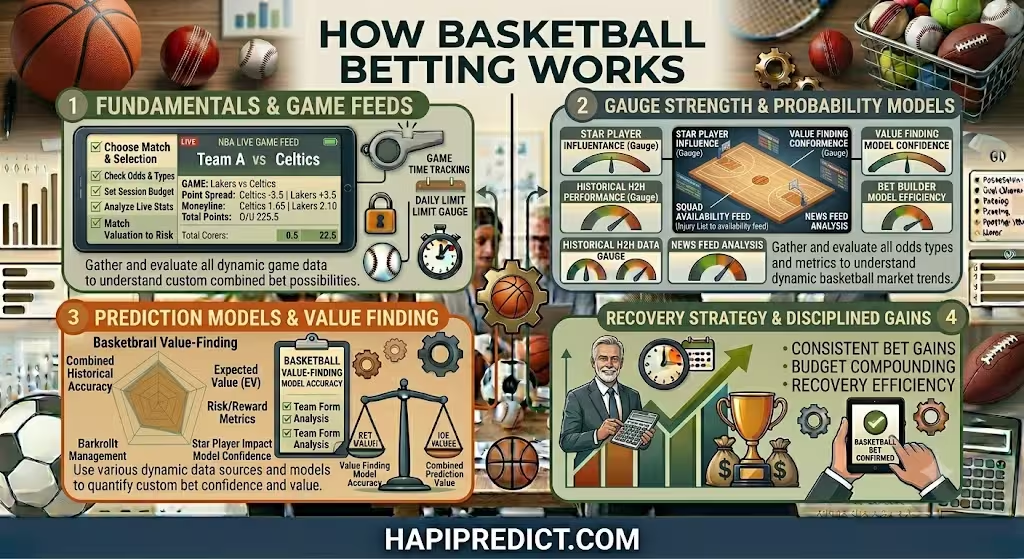
Basketball betting means predicting what may happen in a basketball game, such as which team will win, the point spread, total points, player points, rebounds, assists, or live game markets. It works around scores, quarters, team pace, player roles, injuries, matchups, and how many points both teams are expected to produce.
To understand basketball betting properly, you need to know how moneyline bets, spreads, totals, player props, live odds, and bet settlement rules work. Basketball can change quickly because scoring runs, fouls, substitutions, injuries, and late-game tactics can affect the final result.
What Is Basketball Betting?
Basketball betting is sports betting on basketball games, teams, players, scores, totals, spreads, and live match outcomes. The simplest basketball bet is choosing which team will win the game.
Basketball offers many markets because the sport has high scoring, fast possessions, player statistics, and several game periods. A bettor may choose a match winner, point spread, total points, first quarter winner, player points, rebounds, assists, or same game multi.
For example, if the Los Angeles Lakers play the Boston Celtics, a simple bet may be Lakers to win. A more detailed bet may be Celtics -4.5 spread, over 220.5 total points, Jayson Tatum over 24.5 points, or Lakers to win the first quarter.
Basketball betting should not be based only on team names or league position. A strong team can struggle if key players are injured, if they are playing back-to-back games, if their defense is weak, or if the opponent’s style creates problems.
How Does Basketball Betting Work?
Basketball betting works by choosing a market, selecting an outcome, entering a stake, and waiting for the game or selected market to settle. Your bet wins only if your selection meets the rules of that market.
If you choose the match winner market, your selection must win the game. If you choose a point spread, your selection must cover the handicap line. If you choose over or under total points, the combined score must finish above or below the bookmaker’s line.
Basketball odds can move before and during the game. Before tip-off, odds may change because of injuries, starting lineups, player rest, team news, or betting activity. During live betting, odds can change after every scoring run, foul trouble, timeout, quarter result, or injury.
The most important thing is to understand what your bet needs before you place it. A basketball betting slip can look simple, but each market has its own settlement rule. Match winner, spread, total points, and player props do not settle the same way.
What Are The Main Basketball Betting Markets?
The main basketball betting markets include moneyline, point spread, total points, team totals, quarter betting, half betting, player props, live betting, and same game multi. Each market focuses on a different part of the game.
Common basketball betting markets include:
Match winner or moneyline
Point spread
Total points
Team total points
First quarter winner
First half winner
Player points
Player rebounds
Player assists
Player threes
Double-double or triple-double
Live match winner
Same game multi
Moneyline is usually the easiest market to understand because it only asks who will win. Point spread and totals require more attention because your bet can win or lose even when the team you selected wins the game.
Player props are popular because basketball produces many individual statistics. However, player props can be risky because they depend on minutes, role, fouls, injuries, coach decisions, and game flow.
How Does Moneyline Betting Work In Basketball?
Moneyline betting in basketball means choosing which team will win the game. The score margin does not matter, as long as your selected team wins.
For example, if you bet on the Chicago Bulls moneyline against the Miami Heat, the Bulls must win the game for your bet to win. They can win by 1 point or 30 points. The margin does not affect a moneyline bet.
Moneyline odds are usually lower for favorites and higher for underdogs. If a top team is playing at home against a weaker team, the favorite may have low odds because the bookmaker sees them as more likely to win. If the underdog wins, the higher odds reflect the bigger risk.
Moneyline betting may look simple, but it is not risk-free. Basketball games can change quickly. A favorite may lose because of poor shooting, foul trouble, tired legs, injuries, or a strong opponent run in the final quarter.
How Does Point Spread Betting Work In Basketball?
Point spread betting means betting on a team to win or lose within a margin set by the bookmaker. The spread is used to balance the market between the favorite and the underdog.
If a team is listed as -6.5, they must win by at least 7 points for the spread bet to win. If a team is listed as +6.5, they can win the game or lose by 6 points or fewer for the bet to win.
For example, if the Golden State Warriors are -5.5 against the Dallas Mavericks, the Warriors must win by 6 or more points. If they win by only 3 points, the Warriors win the real game but fail to cover the spread.
If Dallas is +5.5, Dallas wins the spread bet if they win the game outright or lose by 5 points or fewer. This is why the point spread is not only about who wins. It is about the final margin.
Spread betting is popular in basketball because many games have clear favorites. The spread makes the market more competitive, but it also means late free throws, fouls, and final possessions can affect the result.
How Does Over And Under Work In Basketball Betting?
Over and under in basketball betting means predicting whether the total combined score will be higher or lower than the bookmaker’s points line. This market is also called total points betting.
For example, if the total points line is 218.5, betting over means both teams must combine for 219 points or more. Betting under means both teams must combine for 218 points or fewer.
If a game ends 112-108, the total score is 220. Over 218.5 wins, while under 218.5 loses. If the game ends 105-101, the total score is 206, so under 218.5 wins.
Total points betting is affected by pace, shooting quality, defense, injuries, fouls, overtime, and team style. A fast team that takes many shots can push the total higher. A slow team that uses long possessions can reduce scoring chances.
Over and under markets should not be judged only by team popularity. A famous team can still play a low-scoring game if the pace is slow, shots are not falling, or both teams defend well.
How Do Team Totals Work In Basketball Betting?
Team total betting means predicting whether one team will score over or under a specific points line. It focuses on one team’s scoring instead of the full game score.
For example, if the Milwaukee Bucks team total is 113.5, betting over means the Bucks must score at least 114 points. Betting under means they must score 113 points or fewer.
Team totals can be useful when you have a view on one team’s offense or the opponent’s defense. A team may be expected to score well because they are playing at home, facing a weak defense, or getting a key scorer back from injury. Another team may struggle if their main ball-handler is missing or if the opponent defends the paint well.
Team totals can also be affected by blowouts. If one team leads by many points, starters may rest late in the game. That can reduce scoring and affect team total bets.
How Does Quarter Betting Work In Basketball?
Quarter betting means placing a bet on a specific quarter of the game, such as first quarter winner, second quarter total points, or fourth quarter spread. The bet settles based only on that quarter.
For example, if you bet on Team A to win the first quarter, only the first 12 minutes in many professional leagues matter. The final match result does not affect that bet.
Quarter markets are popular because basketball is divided into periods and momentum can change from one quarter to another. A team may start fast but fade later. Another team may use bench players heavily in the second quarter. Some teams are stronger in closing moments because of experienced players and better free-throw shooting.
Quarter betting can be risky because a short period leaves less time for recovery. One cold shooting spell, foul trouble, or bench rotation can affect the quarter result quickly.
How Does First Half Betting Work In Basketball?
First half betting means betting only on the first two quarters of the game. The market settles at half-time and does not depend on the full-time result.
First half markets can include first half winner, first half spread, and first half total points. These markets are useful when you expect a team to start strongly or when you think the first half will be faster or slower than the full game expectation.
For example, a team may be known for strong starts at home. If you believe they will begin with high energy, first half markets may reflect that idea better than full game markets.
However, first half betting still carries risk. Early foul trouble, poor shooting, turnovers, or unexpected rotation can change the result. Because there is less time than a full game, one bad stretch can matter more.
How Do Player Props Work In Basketball Betting?
Player props are bets on individual player statistics, such as points, rebounds, assists, three-pointers, steals, blocks, or turnovers. The bet depends on what the player records in the game.
For example, if a player points line is 24.5 and you bet over, the player must score 25 points or more. If the player scores 24 or fewer, the bet loses.
Player props are popular because basketball is rich in statistics. Fans often follow star players, role players, and matchups closely. However, player props can be affected by many things beyond talent.
Important player prop factors include:
Expected minutes
Injury status
Matchup difficulty
Usage rate
Foul trouble
Team rotation
Game pace
Blowout risk
Back-to-back schedule
Recent role changes
A star player can miss a points line if they take fewer shots, get into foul trouble, face a strong defender, or sit late because the game is already decided. Player props need careful reading, not just player reputation.
How Do Rebounds And Assists Betting Work?
Rebounds and assists betting means predicting whether a player will go over or under a set line for rebounds or assists. These markets depend on role, minutes, team style, and matchup.
For rebounds, size and position matter, but they are not the only factors. A guard can get many rebounds if the team allows them to collect defensive boards and start fast breaks. A center can miss a rebound line if they are in foul trouble or play fewer minutes.
For assists, ball-handling role matters strongly. A player who controls the offense and creates shots for teammates may have higher assist chances. But assists also depend on teammates making shots. A player can pass well and still miss the assist line if teammates shoot poorly.
These markets can look simple, but they require understanding how a team plays. Do not bet a player over assists only because they are famous. Check whether they are actually the main creator in that game situation.
How Does Three-Point Betting Work In Basketball?
Three-point betting means predicting whether a player or team will make over or under a set number of three-point shots. It is based on successful three-pointers, not attempts.
For example, if a player’s three-point line is 2.5, betting over means the player must make at least 3 threes. Betting under means they must make 2 or fewer.
Three-point markets can be affected by shot volume, shooting form, defensive pressure, matchup, and game pace. A player who takes many threes has more chances to go over, but poor shooting can still ruin the bet.
Team three-point markets depend on team style. Some teams rely heavily on outside shooting. Others score more inside the paint. A team facing a defense that allows many open threes may have a better chance of a higher three-point total.
The key point is that attempts and makes are different. A player may attempt many threes but make only a few.
How Does Live Basketball Betting Work?
Live basketball betting means placing bets while the game is already happening. The odds change during the game based on score, time, momentum, fouls, injuries, rotations, and scoring runs.
Basketball live betting moves quickly because points are scored often. A team can go on a 10-0 run in a few minutes, and the odds can change sharply. A favorite may fall behind early, then recover before half-time. An underdog may start well but struggle when bench units enter.
Live markets may include match winner, live spread, live total points, quarter winner, next scoring team, and player props. Some markets may be suspended during timeouts, injuries, reviews, or fast scoring changes.
Live basketball betting can be risky because it creates pressure to act quickly. It is better to miss a price than to place a rushed bet based on one scoring run.
Why Do Basketball Odds Change Before A Game?
Basketball odds change before a game because of injuries, player rest, starting lineups, betting activity, schedule difficulty, and market information. A single player update can move the market strongly.
In basketball, one key player can have a large impact. If a star scorer, main defender, or starting point guard is ruled out, the moneyline, spread, total points, and player props may all change.
Back-to-back games can also affect odds. A team playing on the second night of a back-to-back may rest players or show fatigue. Travel, home advantage, and schedule pressure can also matter.
Before placing a basketball bet, check team news carefully. Betting before injury updates can be risky because the market may change after official lineups or availability reports.
How Does Overtime Affect Basketball Bets?
Overtime can affect basketball bets because many full-game markets include overtime unless the betting site states otherwise. This can change moneyline, spread, totals, and player props.
For example, if you bet over 218.5 total points and the game is tied at 105-105 after regulation, overtime can push the total above the line. If you bet under, overtime can turn a winning position into a losing one.
Overtime can also affect player props. Extra minutes give players more chances to score, rebound, assist, or make threes. This can help over bets but hurt under bets.
However, some quarter, half, or regulation-only markets may not include overtime. Always check the market rules before placing the bet. Do not assume every basketball market includes the same time period.
How Does Team News Affect Basketball Betting?
Team news affects basketball betting because injuries, rest decisions, suspensions, and lineup changes can change how a team scores and defends. Basketball teams rely heavily on roles and minutes.
If a starting point guard is out, the team may lose playmaking. If a center is out, rebounding and rim protection may suffer. If a star scorer is unavailable, other players may take more shots, and player prop lines may change.
Team news also affects rotation. A bench player may become a starter and receive more minutes. A role player may become more important if a star is missing.
Basketball betting without team news is risky because markets react quickly to injury reports. A bet that looked reasonable in the morning may look weaker after lineup updates.
How Can You Analyze A Basketball Game Before Betting?
You can analyze a basketball game by checking form, injuries, pace, defense, offensive style, player roles, schedule, home advantage, and recent matchups. These factors help explain why a market may be risky or reasonable.
Useful basketball analysis should include:
Recent team form
Injury report
Starting lineup
Home or away record
Pace of play
Defensive strength
Offensive efficiency
Rebounding matchup
Turnover risk
Back-to-back schedule
Player minutes and roles
Head-to-head style matchup
No factor guarantees the result. Basketball is fast, and a game can change through shooting variance, foul trouble, coaching adjustments, and late-game decisions.
The goal of analysis is not to find a sure bet. The goal is to understand what can go right, what can go wrong, and whether the risk is worth considering.
What Are Common Basketball Betting Mistakes?
Common basketball betting mistakes include betting only on favorite teams, ignoring injuries, misunderstanding spreads, chasing live bets, and focusing only on player names instead of roles.
Basketball can make bettors overreact because scoring runs happen often. A team may look terrible in the first quarter and still win. Another team may lead by 15 points and still lose. This fast movement can lead to emotional betting.
Common mistakes include:
Betting without checking injury news
Choosing favorites only because they are popular
Misreading point spreads
Ignoring overtime rules
Betting on player props without checking minutes
Chasing losses during live games
Ignoring back-to-back fatigue
Betting too much on one game
Adding too many selections to same game multis
Avoiding these mistakes requires patience. If you do not understand the market clearly, it is safer not to place the bet.
Is Basketball Betting Risky?
Yes, basketball betting is risky because no result is guaranteed. Injuries, foul trouble, scoring runs, overtime, poor shooting, substitutions, and coaching decisions can all change the outcome.
Even strong favorites can lose. A team may have a bad shooting night. A key player may get injured. A star may enter foul trouble. A bench unit may perform badly. The final minutes can also change spreads and totals quickly.
The risk increases when people bet emotionally, chase losses, use money meant for important needs, or place live bets without thinking. Basketball has many markets, but more markets do not mean safer betting.
Responsible basketball betting means using small stakes, setting limits, avoiding emotional decisions, and accepting that every bet can lose.
How Can You Manage Money In Basketball Betting?
You can manage money in basketball betting by setting a fixed budget, using small stakes, tracking your bets, and stopping when your limit is reached. Betting money should be separate from important money.
Basketball games can run across many leagues and time zones, so it is easy to place too many bets in one day. A person may bet on one game, then another, then live markets, then player props. Without limits, small stakes can add up quickly.
A safer money approach includes:
Set a daily or weekly betting budget.
Use only money you can afford to lose.
Keep stake sizes small.
Avoid chasing losses after one game.
Do not increase stakes because a favorite looks strong.
Track wins, losses, deposits, and withdrawals.
Stop when your budget is finished.
Never bet with money meant for food, rent, school fees, savings, debt, business, transport, or family needs. If losing the stake will create stress, the bet should not be placed.
? Frequently Asked Questions
What Does Basketball Betting Mean? ⌄
How Does Point Spread Work In Basketball? ⌄
What Does Over And Under Mean In Basketball? ⌄
Do Basketball Bets Include Overtime? ⌄
What Are Player Props In Basketball? ⌄
Is Basketball Betting Good For Beginners? ⌄
Related Articles
📬 Free Daily Predictions
Get expert picks delivered to your inbox every morning.