How Horse Racing Odds Work

Want expert predictions delivered daily?
Get free tips on Telegram or upgrade to Premium.
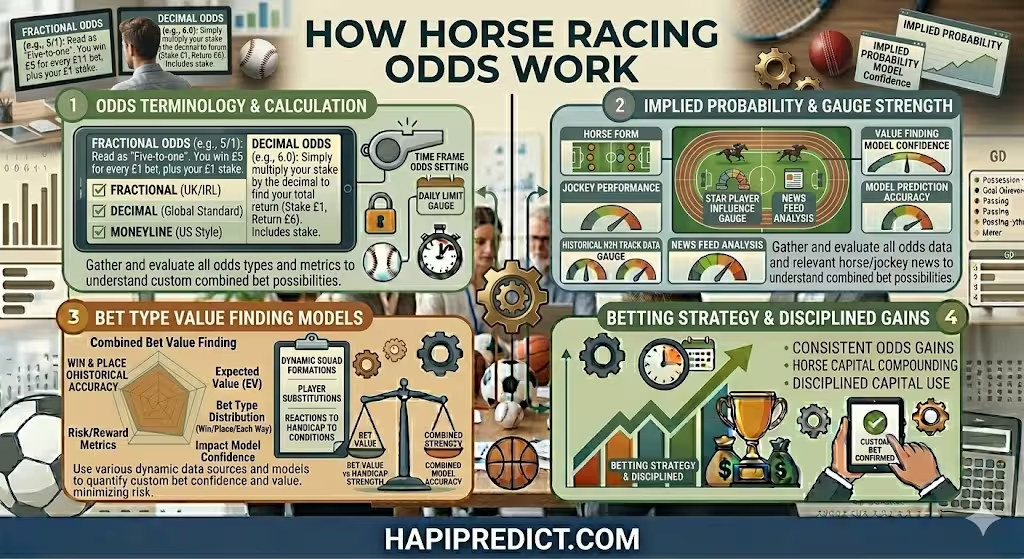
Horse racing odds show how much you may receive if your horse wins or places, and they also reflect how likely the market thinks that horse is to perform well. Lower odds usually mean a horse is seen as more likely to win, while higher odds usually mean the horse is seen as less likely.
Horse racing odds can change quickly before a race because of market movement, betting activity, race conditions, non-runners, jockey news, ground conditions, and public confidence. To understand them properly, you need to know how odds formats work, how payouts are calculated, and why the price on a horse can shorten or drift.
What Are Horse Racing Odds?
Horse racing odds are the prices attached to each horse in a race. They show the potential return on a winning bet and give an idea of how the betting market views each horse’s chance.
For example, a horse with low odds is usually considered one of the stronger runners in the race. A horse with high odds is usually seen as less likely to win, but it may offer a bigger return if it does win.
Odds are not guarantees. A short-priced favorite can lose, and a long-shot horse can win. Horse racing has many moving parts, including form, jockey, trainer, distance, draw, ground, pace, weight, and race tactics. These factors make every race uncertain.
The key point is simple. Odds help you understand the price of the risk, but they do not remove the risk.
How Do Horse Racing Odds Work?
Horse racing odds work by showing how much profit or total return you can receive from your stake if the bet wins. The odds also move based on how the market reacts before the race.
If you place a bet at fixed odds, your payout is usually based on the odds accepted when the bet was placed. If you place a bet at starting price, your payout is based on the official price when the race starts.
For example, if you bet ₦1,000 on a horse at decimal odds of 5.00 and the horse wins, your total return is ₦5,000. That includes your ₦1,000 stake and ₦4,000 profit.
The basic decimal odds formula is:
Stake × Odds = Total Return
Horse racing odds may look simple on the surface, but you should also understand the bet type. A win bet, each-way bet, place bet, forecast, and tricast do not settle the same way.
What Do Short Odds Mean In Horse Racing?
Short odds in horse racing mean the horse is seen as more likely to win compared to other runners. The possible return is smaller because the market believes the horse has a stronger chance.
For example, a horse priced at 1.80 is a shorter price than a horse priced at 8.00. If the 1.80 horse wins, the return is lower because the market already expected it to perform strongly.
Short odds often appear on favorites. A favorite may have strong recent form, a top jockey, a good trainer record, suitable ground, strong speed figures, or a race setup that appears favorable.
However, short odds do not mean a horse is safe. A favorite can start slowly, get blocked, struggle with the pace, dislike the ground, make a jumping mistake, or fail to finish strongly. In horse racing, even strong runners can lose.
What Do Long Odds Mean In Horse Racing?
Long odds in horse racing mean the horse is seen as less likely to win, but the possible return is higher if it does win. These horses are often called outsiders or long shots.
For example, a horse priced at 20.00 offers a much bigger return than a horse priced at 2.00, but the higher odds usually reflect a lower expected chance of winning.
A horse may have long odds because of poor recent form, a difficult draw, unsuitable distance, weaker jockey booking, poor trainer form, higher weight, or strong rivals in the race. Sometimes a horse is simply not trusted by the market.
Long odds can look attractive because the potential payout is big, but they carry higher risk. A big return on the slip does not mean the bet is good. It only means the result is considered harder to land.
How Do Decimal Odds Work In Horse Racing?
Decimal odds show the total return you may receive for every unit staked. They include both your original stake and profit.
For example, if a horse has decimal odds of 4.50 and you stake ₦1,000, the total return is ₦4,500 if the horse wins. Your profit is ₦3,500 because your ₦1,000 stake is included in the return.
Here are simple examples:
₦1,000 at odds of 2.00 returns ₦2,000
₦1,000 at odds of 3.50 returns ₦3,500
₦1,000 at odds of 6.00 returns ₦6,000
₦1,000 at odds of 10.00 returns ₦10,000
Decimal odds are easy to read because the calculation is straightforward. But you should still check whether the bet is win only, place, each-way, or another race market because the payout rules may differ.
How Do Fractional Odds Work In Horse Racing?
Fractional odds show how much profit you can make compared to your stake. They are common in traditional horse racing markets.
For example, odds of 5/1 mean you can make 5 units of profit for every 1 unit staked. If you stake ₦1,000 at 5/1 and the horse wins, your profit is ₦5,000 and your total return is ₦6,000 including your stake.
Odds of 2/1 mean ₦2,000 profit for every ₦1,000 stake. Odds of 1/2 mean ₦500 profit for every ₦1,000 stake, because the horse is strongly favored.
Fractional odds can feel confusing at first, but the idea is simple. The first number shows the profit, and the second number shows the stake size used for the comparison.
If you prefer easier calculations, decimal odds may be simpler. Many betting sites allow users to switch odds format inside account settings.
What Is Starting Price In Horse Racing?
Starting price, often called SP, is the official price of a horse when the race begins. If you place a bet at SP, your payout is based on the final starting price, not the price shown earlier.
For example, a horse may be priced at 6.00 in the morning, 5.00 one hour before the race, and 4.50 at the start. If you took SP, your bet would settle at the official starting price.
SP can be useful when you do not want to choose early odds, but it also means you do not know the exact payout until the race starts. The price may shorten, which reduces your possible return, or drift, which increases it.
Some bettors prefer fixed odds because they know the price immediately. Others use SP when they believe the market may move in their favor. Neither option guarantees a better result.
What Are Fixed Odds In Horse Racing?
Fixed odds mean the price is locked in when you place the bet. If the horse’s odds change later, your bet still settles at the odds you accepted, unless special rules or deductions apply.
For example, if you back a horse at 7.00 and it later shortens to 4.50, your bet still keeps the 7.00 price. That can be helpful if you took a higher price before market support came in.
But fixed odds can also work against you. If you back a horse at 4.00 and it later drifts to 8.00, your bet stays at 4.00. You do not receive the higher later price unless your bookmaker offers a best odds feature and the rules apply.
Fixed odds give certainty on the price, but they do not guarantee the result. The horse still has to meet the bet conditions.
Why Do Horse Racing Odds Change?
Horse racing odds change because the market reacts to new information, betting activity, runner confidence, ground conditions, jockey changes, trainer form, and non-runners. A horse’s price can shorten or drift before the race starts.
When a horse shortens, its odds become lower. This often means more money is coming for that horse or the market views it more positively. When a horse drifts, its odds become higher. This may mean less confidence, stronger support for other runners, or new information affecting the market.
Odds may change because of:
Heavy betting support
Ground or weather changes
Non-runners
Jockey changes
Trainer comments
Market confidence
Racecourse reports
Strong or weak form analysis
Public betting trends
Odds movement can be useful information, but it should not be followed blindly. A shortening price does not guarantee a win, and a drifting horse is not automatically a bad selection.
What Does A Horse Shortening In Odds Mean?
A horse shortening in odds means its price is getting lower. This usually suggests the market is becoming more confident about that horse’s chance.
For example, if a horse moves from 8.00 to 5.00, it has shortened. The possible return is now lower because the market considers the horse more likely than before.
A horse may shorten because many bettors are backing it, because the ground suits it, because a rival is withdrawn, or because expert opinion is moving in its favor. Sometimes a horse shortens because of strong stable confidence or improved race conditions.
However, a shortening price is not proof that the horse will win. It only shows that the market has moved. You should still check form, distance, ground, pace, draw, jockey, and race conditions.
What Does A Horse Drifting In Odds Mean?
A horse drifting in odds means its price is getting higher. This usually suggests the market has become less confident about that horse or more interested in other runners.
For example, if a horse moves from 3.00 to 5.50, it has drifted. The possible payout is now bigger, but the market is treating the horse as less likely than before.
A horse may drift because of weak market support, concerns about ground, doubts about fitness, a difficult draw, strong support for rivals, or negative racecourse signals. Sometimes a horse drifts simply because another horse is heavily backed.
A drifting horse can still win. Odds movement should be treated as one piece of information, not the full decision. Some horses drift and still run well. Others shorten and disappoint.
How Do Each-Way Odds Work In Horse Racing?
Each-way betting splits your stake into two parts, one part on the horse to win and one part on the horse to place. It can return money if the horse finishes in one of the qualifying place positions.
For example, if you place ₦1,000 each-way, your total stake is usually ₦2,000. ₦1,000 goes on the horse to win, and ₦1,000 goes on the horse to place. If the horse wins, both parts can pay. If the horse places but does not win, only the place part pays.
The place payout is usually a fraction of the win odds. The exact place terms depend on the race type, number of runners, and bookmaker rules.
Each-way betting is popular in larger fields where a horse may have a good chance of running well without necessarily winning. However, the total stake is doubled because you are placing two bets.
How Do Place Odds Work In Horse Racing?
Place odds pay if your horse finishes within the qualifying place positions. The number of places paid depends on the race, field size, bookmaker terms, and market rules.
For example, in some races, the place terms may pay the first three finishers. In bigger handicap races, more places may be offered. In smaller races, fewer places may count.
A place bet can be useful when you think a horse may run well but may not be strong enough to win. However, place odds are usually lower than win odds because the horse has more ways to qualify for a payout.
Always check the place terms before betting. Do not assume every race pays the same number of places. A race with fewer runners may offer fewer place positions.
How Do Odds Work When A Horse Is A Non-Runner?
When a horse becomes a non-runner, bets on that horse are usually void and the stake is returned. Bets on other horses may be affected by deductions if the market changes significantly.
A non-runner means the horse does not take part in the race. If you backed that horse, your stake is usually refunded because the horse did not run.
However, if another horse is withdrawn after you placed a bet, your bet on a remaining horse may still stand, but the payout may be adjusted under the bookmaker’s deduction rules. This is because the removal of a runner can make the race easier for the remaining horses and change the market.
Non-runner rules are important in horse racing because fields can change before the race. Always check how your bookmaker handles non-runners, refunds, and deductions.
What Are Rule 4 Deductions In Horse Racing?
Rule 4 deductions are reductions applied to winning payouts when a horse is withdrawn after bets have already been placed. The deduction reflects the changed race market after a non-runner is removed.
For example, if a strong horse is withdrawn, the remaining horses may have a better chance of winning. Bookmakers may reduce payouts on winning bets placed before the withdrawal because the original odds were based on a stronger field.
The deduction amount depends on the withdrawn horse’s price at the time it was removed. A short-priced non-runner can cause a bigger deduction than a long-priced non-runner because it had more impact on the market.
Rule 4 can surprise beginners because a winning bet may pay less than expected. It does not mean the bet was settled wrongly. It means the race conditions changed after the original price was taken.
How Do Odds Work In Win Bets?
A win bet means your horse must finish first for the bet to win. If the horse finishes second, third, or lower, the win bet loses unless you used an each-way or place market.
For example, if you bet ₦1,000 on a horse to win at odds of 6.00 and the horse finishes first, your total return is ₦6,000. If the horse finishes second, the win bet loses.
Win betting is simple to understand, but it can be difficult because only one horse wins the race. The bigger the field, the more rivals your horse must beat.
Before placing a win bet, consider whether the horse has the right race conditions. Distance, ground, draw, pace, trainer form, jockey ability, and recent performance all matter.
How Do Forecast And Tricast Odds Work?
Forecast and tricast bets require you to predict the finishing order of horses. A forecast usually predicts first and second, while a tricast usually predicts first, second, and third.
A straight forecast means you must pick the exact first and second in the correct order. A reverse forecast gives more flexibility because your two horses can finish first and second in either order.
A straight tricast is harder because the first three horses must finish in the exact order. This makes the bet more difficult than a simple win or place bet.
These markets can offer bigger returns because they are harder to land. But they carry high risk because the finishing order must be very specific. One horse finishing in the wrong position can lose the bet.
How Does Form Affect Horse Racing Odds?
Form affects horse racing odds because it shows how a horse has performed in previous races. Strong recent form can shorten a horse’s price, while poor form can make the odds bigger.
Form can include finishing position, race distance, ground conditions, class level, speed, pace, and how the horse finished the race. A horse that won recently may attract support, but the quality of that win matters.
For example, a horse that won easily in a weaker race may not be as strong when moving into a tougher race. Another horse may have finished fourth but ran well against stronger rivals and may be more interesting than the result suggests.
Form should be read with context. Do not only look at finishing position. Check the race conditions behind the result.
Why Do Ground Conditions Affect Horse Racing Odds?
Ground conditions affect horse racing odds because some horses perform better on firm ground, while others prefer soft or heavy ground. If the ground changes, the market can move.
A horse that runs well on firm ground may struggle when the ground becomes soft. Another horse may improve when the ground is heavy because it has stamina and handles slower conditions better.
Ground conditions can affect speed, stamina, jumping, finishing strength, and race tactics. In wet conditions, races can become more demanding. On faster ground, speed may matter more.
Before betting, check whether the horse has performed well on similar ground before. A change in ground can explain why odds shorten or drift before the race.
Why Do Jockey And Trainer Matter In Horse Racing Odds?
Jockey and trainer matter because they influence preparation, race tactics, timing, confidence, and decision-making. A strong jockey booking or a trainer in good form can affect market confidence.
A trainer prepares the horse, chooses race targets, manages fitness, and decides when the horse is ready. A trainer with strong recent results may attract more market support.
A jockey controls the ride during the race. Positioning, pace judgment, timing, and calm decision-making can affect the final result. A skilled jockey can give a horse a better chance, but even the best jockey cannot guarantee a win.
Market confidence may increase when a respected jockey rides for a strong trainer. But it should still be considered alongside form, ground, distance, draw, and race pace.
How Can You Read Horse Racing Odds Before Betting?
You can read horse racing odds by checking the price, market movement, race type, field size, form, ground, draw, jockey, trainer, and betting terms. Odds should be viewed alongside race analysis, not alone.
Before betting on horse racing odds, ask:
Is the horse a favorite, outsider, or mid-priced runner?
Has the price shortened or drifted?
Does the ground suit the horse?
Is the distance suitable?
Is the jockey booking strong?
Is the trainer in good form?
Are there any non-runners?
What are the place terms?
Is the bet fixed odds or starting price?
Can I afford to lose the stake?
This kind of check helps you avoid betting only because the price looks big or because the horse is popular.
Is Horse Racing Betting Risky?
Yes, horse racing betting is risky because no horse is guaranteed to win. Race pace, ground, draw, jumping, jockey decisions, traffic problems, fitness, and non-runners can all affect the result.
A favorite can lose even when the odds are short. A horse can start well but fade late. Another can be blocked at the wrong time. In jump racing, mistakes at fences can change everything quickly.
The risk increases when people chase losses, over-stake, or bet on many races without proper thought. Horse racing has many daily markets, so small bets can add up.
Responsible betting means using small stakes, setting limits, understanding the market, and never betting with money meant for food, rent, school fees, savings, debt, transport, business, or family needs.
? Frequently Asked Questions
What Do Horse Racing Odds Mean? ⌄
How Do You Calculate Horse Racing Odds? ⌄
What Does A Horse Shortening In Odds Mean? ⌄
What Does A Horse Drifting In Odds Mean? ⌄
What Happens If My Horse Is A Non-Runner? ⌄
Are Low Odds Horses Safe To Bet On? ⌄
Related Articles
📬 Free Daily Predictions
Get expert picks delivered to your inbox every morning.