How Statistics Help Sports Analysis

Want expert predictions delivered daily?
Get free tips on Telegram or upgrade to Premium.
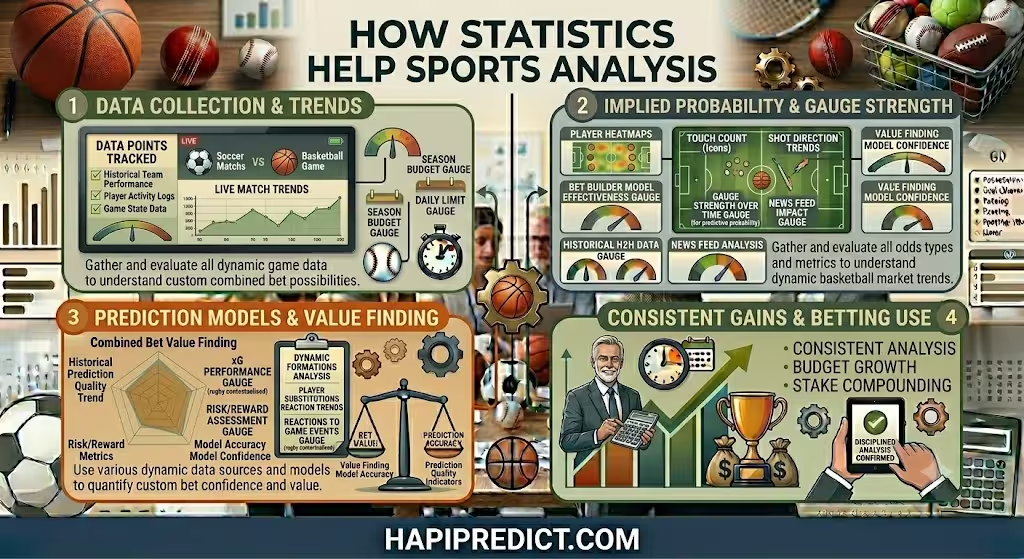
Statistics help sports analysis by turning match events, player actions, team performance, and results into useful information. They make it easier to understand form, strengths, weaknesses, tactics, consistency, and match trends before making a sports judgment.
Sports analysis should not rely only on opinions, emotions, or team reputation. Statistics give clearer evidence, but they must be read with context because numbers can explain a lot, but they do not guarantee what will happen next.
What Are Sports Statistics?
Sports statistics are numbers that measure what happens in a match, season, tournament, or player performance. They help explain how teams and players are performing beyond the final score.
In football, statistics can include goals, assists, shots, shots on target, possession, expected goals, corners, tackles, saves, and clean sheets. In basketball, they may include points, rebounds, assists, turnovers, field goal percentage, and pace. In cricket, they include runs, wickets, strike rate, economy rate, partnerships, and batting average.
Sports statistics are useful because the final result does not always tell the full story. A team may lose 1-0 but create many chances. Another team may win 2-0 but spend most of the match defending. Statistics help reveal what happened underneath the scoreline.
However, stats should not be used blindly. A number is only useful when you understand what it means and why it happened.
Why Are Statistics Important In Sports Analysis?
Statistics are important in sports analysis because they give evidence for judging teams, players, form, tactics, and match patterns. They help reduce guesswork and emotional opinions.
Without statistics, analysis can become too dependent on reputation. A famous team may be assumed to be strong even when recent numbers show poor defending, weak chance creation, or bad away form. A smaller team may be ignored even when the stats show improvement.
Statistics also help compare teams more fairly. Instead of saying one team “looks better,” you can check goals scored, goals conceded, shots created, defensive record, home form, away form, and recent performances.
Good sports analysis uses statistics to answer practical questions:
Is the team creating enough chances?
Is the defense allowing too many shots?
Is the player in good form?
Is the team stronger at home or away?
Are recent wins supported by strong performances?
Is the team relying on luck, penalties, or late goals?
Stats make analysis more structured, but they still need context.
How Do Statistics Help You Understand Team Form?
Statistics help you understand team form by showing whether recent results are supported by strong performances. A team’s form is not only about wins, draws, and losses.
For example, a football team may win three matches in a row, but the stats may show they had very few shots and relied on late goals. Another team may lose two matches but create many chances and concede from rare mistakes. The form table alone may not show that difference.
Useful team form statistics include:
Recent wins, draws, and losses
Goals scored
Goals conceded
Shots created
Shots allowed
Clean sheets
Expected goals
Possession quality
Home and away results
Strength of opponents faced
Good analysis asks whether form is sustainable. A team winning while creating little may be vulnerable later. A team losing while performing well may improve if finishing or defensive mistakes settle.
How Do Statistics Help Compare Two Teams?
Statistics help compare two teams by showing where each side is strong, weak, consistent, or vulnerable. This makes match analysis more balanced.
For example, before a football match, you may compare both teams using goals scored, goals conceded, shots on target, set-piece record, clean sheets, pressing style, home form, and away form. This gives a clearer view than simply checking league position.
A team higher on the table is not always better in every area. One team may have stronger attack, while the other has better defense. One may dominate possession, while the other is dangerous on counterattacks. Statistics help show these differences.
When comparing two teams, it is useful to check:
Recent form
Home and away performance
Attacking output
Defensive strength
Goal trends
Player availability
Head-to-head context
Strength of recent opponents
Set-piece performance
Discipline record
The aim is not to let one statistic decide everything. The aim is to build a full picture.
How Do Goals And Scoring Stats Help Sports Analysis?
Goals and scoring stats help sports analysis by showing how often a team or player turns opportunities into results. They are among the most common numbers used in match previews and performance reviews.
In football, goals scored and goals conceded can show attacking strength and defensive weakness. In basketball, points per game can show offensive output. In rugby, tries and points scored show how well a team converts pressure into points.
However, scoring stats need context. A football team may score many goals against weak opponents but struggle against stronger defenses. A basketball team may score heavily because it plays at a fast pace, not necessarily because it is highly efficient.
Scoring numbers are useful, but they should be compared with other data like chance creation, shot quality, opponent strength, and match situation. A team that scores early may defend more afterward, which can affect the rest of the match statistics.
How Do Defensive Stats Help Sports Analysis?
Defensive stats help sports analysis by showing how well a team prevents chances, goals, points, or pressure. A strong defense is not only about clean sheets.
In football, useful defensive stats include goals conceded, shots allowed, tackles, interceptions, blocks, saves, expected goals against, and clean sheets. A team may keep a clean sheet because the goalkeeper made many saves, while another may keep a clean sheet because the opponent barely created anything.
In basketball, defensive stats may include points allowed, defensive rebounds, steals, blocks, opponent shooting percentage, and turnovers forced. In rugby, tackles made, missed tackles, penalties conceded, and territory control can reveal defensive quality.
A good defense reduces danger before it becomes obvious. That is why defensive stats should go beyond the final score. A team that repeatedly allows many chances may eventually concede more goals or points.
How Do Home And Away Stats Help Match Analysis?
Home and away stats help match analysis because many teams perform differently depending on venue. Some teams are much stronger at home, while others struggle when traveling.
Home advantage can come from crowd support, familiar pitch conditions, less travel, confidence, and routine. Away matches can be harder because of travel, different atmosphere, unfamiliar conditions, and tactical pressure.
For example, a football team may have strong home scoring numbers but poor away results. If you only check the league table, you may miss that pattern. A basketball team may shoot better at home and defend worse on the road. A cricket team may perform differently depending on pitch and local conditions.
Home and away stats are especially useful when comparing teams with similar overall records. The match venue can change the meaning of the numbers.
How Do Player Statistics Help Sports Analysis?
Player statistics help sports analysis by showing individual contribution, form, consistency, and role within a team. They help explain which players influence results most.
In football, player stats may include goals, assists, shots, key passes, tackles, interceptions, saves, expected goals, and minutes played. In basketball, they may include points, rebounds, assists, steals, blocks, turnovers, and shooting percentage. In cricket, they include runs, wickets, strike rate, economy rate, and batting average.
Player stats are important because a team’s overall numbers can change when key players are missing. A team may create fewer chances without its main playmaker. A defense may become weaker without a leading center-back. A cricket side may lose balance without a key bowler.
Still, player stats should be read with role and context. A defensive midfielder may not score often but may be vital to team structure. A striker may have fewer touches but still decide matches.
How Do Injury And Availability Stats Affect Analysis?
Injury and availability stats affect analysis because teams are not the same when key players are missing. A strong team can become weaker if important players are injured, suspended, rested, or unavailable.
Availability changes the meaning of team statistics. A club may have strong season numbers, but if its best scorer, goalkeeper, defender, or playmaker is missing, past numbers may not fully reflect the current match situation.
For example, a football team’s scoring average may drop when its main striker is absent. A basketball team may play slower without its lead guard. A cricket team may struggle if its best bowler is unavailable.
Good analysis checks not only who is missing, but how important that player is. A famous player may have a strong replacement, while a less famous player may be harder to replace because of their role in the system.
How Do Head-To-Head Stats Help Sports Analysis?
Head-to-head stats show past results between two teams or players. They can help identify patterns, but they should not be treated as the strongest factor in analysis.
For example, one team may have beaten another several times in recent meetings. That may suggest a style advantage or psychological edge. However, teams change over time. Managers, players, tactics, injuries, and form can make old head-to-head records less useful.
Head-to-head stats are most helpful when the matches are recent and the teams are still similar. They are less useful when the squads, coaches, or competition level have changed.
A good way to use head-to-head data is to ask:
Were the matches recent?
Were the same key players involved?
Was the same coach in charge?
Were the match conditions similar?
Did one team’s style clearly trouble the other?
Head-to-head stats should support analysis, not control it.
How Do Possession Stats Help Sports Analysis?
Possession stats show how much a team controls the ball, but they do not always show which team played better. Possession must be judged alongside chance creation and match control.
A football team may have 65% possession but create few clear chances. Another team may have 35% possession but create dangerous counterattacks. This means possession alone can be misleading.
Possession can help explain playing style. Some teams build slowly and control territory. Others defend deep and attack quickly. Both approaches can work depending on the opponent and match situation.
Possession becomes more useful when combined with:
Shots created
Chances created
Passing accuracy
Territory
Final-third entries
Expected goals
Defensive pressure
Match score at the time
The key is not who had more of the ball. The key is what the team did with it.
How Do Shot Stats Help Football Analysis?
Shot stats help football analysis by showing how often a team creates attempts on goal and how dangerous those attempts may be. They are more useful when separated into total shots, shots on target, and shot quality.
A team with many shots is not always dangerous if most shots are weak or from far away. A team with fewer shots may still create better chances if those shots come from close range or strong attacking positions.
For example, Team A may have 18 shots but only 3 on target. Team B may have 8 shots with 5 on target and better chances. The basic shot count may favor Team A, but the quality may favor Team B.
Shot stats help reveal attacking pressure, but they should be read with match context. A team chasing the game may shoot more because it is desperate, not because it is in full control.
How Do Advanced Stats Help Sports Analysis?
Advanced stats help sports analysis by measuring performance more deeply than basic scores and results. They can reveal chance quality, efficiency, pressure, and hidden strengths or weaknesses.
In football, expected goals, often called xG, estimates the quality of chances based on factors like shot location, angle, and type of chance. Expected goals against can show how many good chances a team allows. In basketball, advanced stats may include offensive rating, defensive rating, usage rate, true shooting percentage, and pace.
Advanced stats are useful because they explain performance behind the result. A team may win 1-0 but have a low xG, meaning the win came from limited chances. Another team may lose but create enough chances to suggest better future performances.
Advanced stats should still be used carefully. They are tools, not final answers. Different models may measure things differently, and no statistic captures every part of sport.
How Do Recent Stats And Season Stats Differ?
Recent stats show current form, while season stats show long-term performance. Both are useful, but they answer different questions.
Recent stats help reveal whether a team is improving, declining, dealing with injuries, or changing tactics. Season stats show broader consistency and reduce the risk of overreacting to one or two matches.
For example, a team may have excellent season numbers but poor recent form because of injuries. Another team may have weak season numbers but strong recent performances after changing coach or formation.
Good analysis compares both:
Season stats show the bigger picture
Recent stats show current direction
Home and away stats show venue impact
Opponent strength shows quality of results
Using only recent stats can make you overreact. Using only season stats can make you miss current changes.
How Do Statistics Help Tactical Analysis?
Statistics help tactical analysis by showing how a team plays, where it creates chances, how it defends, and what patterns repeat across matches.
For example, a football team with many crosses may rely on wide play. A team with high pressing numbers may try to win the ball early. A basketball team with many three-point attempts may depend heavily on outside shooting. A cricket team with strong spin bowling numbers may be more dangerous on turning pitches.
Tactical stats can help answer:
Does the team attack centrally or wide?
Does the team press high or defend deep?
Does the team rely on set pieces?
Does the team start fast or finish strong?
Does the team struggle against certain styles?
Does the opponent’s strength match its weakness?
Tactics give meaning to numbers. Statistics show what is happening, while tactical analysis explains why it may be happening.
How Do Statistics Help Betting Decisions?
Statistics can help betting decisions by making analysis more evidence-based, but they do not guarantee any outcome. They help people understand risk, compare teams, and avoid relying only on emotion or reputation.
For example, before betting on over goals, someone may check scoring form, defensive record, shot volume, injuries, weather, and recent match tempo. Before backing a team to win, they may check home form, away form, player availability, and strength of recent opponents.
Statistics can improve understanding, but they should not create overconfidence. A team with strong numbers can still lose. A player in good form can still underperform. Sports results remain uncertain.
Responsible betting decisions should combine statistics with small stakes, clear limits, and the understanding that every bet can lose.
What Are Common Mistakes When Using Sports Statistics?
Common mistakes include using one statistic alone, ignoring context, overvaluing old data, and treating numbers as guarantees. Statistics are useful, but they can mislead when read badly.
A team’s high possession does not always mean dominance. A striker’s recent goals do not always mean they will score again. A strong head-to-head record may not matter if the teams have changed. A clean sheet may hide the fact that the goalkeeper made many difficult saves.
Common mistakes include:
Looking only at final scores
Ignoring opponent strength
Using old head-to-head records blindly
Treating possession as control
Ignoring injuries and lineup changes
Overreacting to one match
Ignoring home and away differences
Assuming stats guarantee future results
Good analysis asks what the numbers mean, not just what the numbers are.
How Can Beginners Use Statistics In Sports Analysis?
Beginners can use statistics by starting with simple numbers, then adding context. It is better to understand a few useful stats well than to collect many numbers without meaning.
A beginner can start with:
Recent form
Goals or points scored
Goals or points conceded
Home and away record
Shots or chances created
Player availability
Strength of opponents
Head-to-head context
After that, advanced stats like expected goals, efficiency ratings, pace, and shot quality can be added.
The goal is not to sound technical. The goal is to understand the match better. If a statistic does not help explain performance, it may not be useful for that analysis.
How Can You Use Sports Statistics Responsibly?
You can use sports statistics responsibly by treating them as evidence, not guarantees. Statistics should support clear thinking, not replace judgment.
Responsible sports analysis means checking numbers, understanding context, and accepting uncertainty. A good statistic can guide you, but it cannot control injuries, referee decisions, weather, pressure, or unexpected mistakes.
A safer approach includes:
Use more than one statistic
Check recent and long-term data
Compare home and away performance
Consider injuries and suspensions
Look at opponent strength
Avoid forcing conclusions
Accept that results can still surprise you
Statistics are most powerful when they make you more careful. If they make you feel certain, you may be reading them the wrong way.
? Frequently Asked Questions
What Are Sports Statistics? ⌄
Why Are Statistics Important In Sports Analysis? ⌄
Can Statistics Predict Sports Results? ⌄
What Are The Best Stats For Football Analysis? ⌄
How Do Statistics Help Compare Teams? ⌄
Should Beginners Use Advanced Sports Stats? ⌄
Related Articles
📬 Free Daily Predictions
Get expert picks delivered to your inbox every morning.