How Betting Margins Work

Want expert predictions delivered daily?
Get free tips on Telegram or upgrade to Premium.
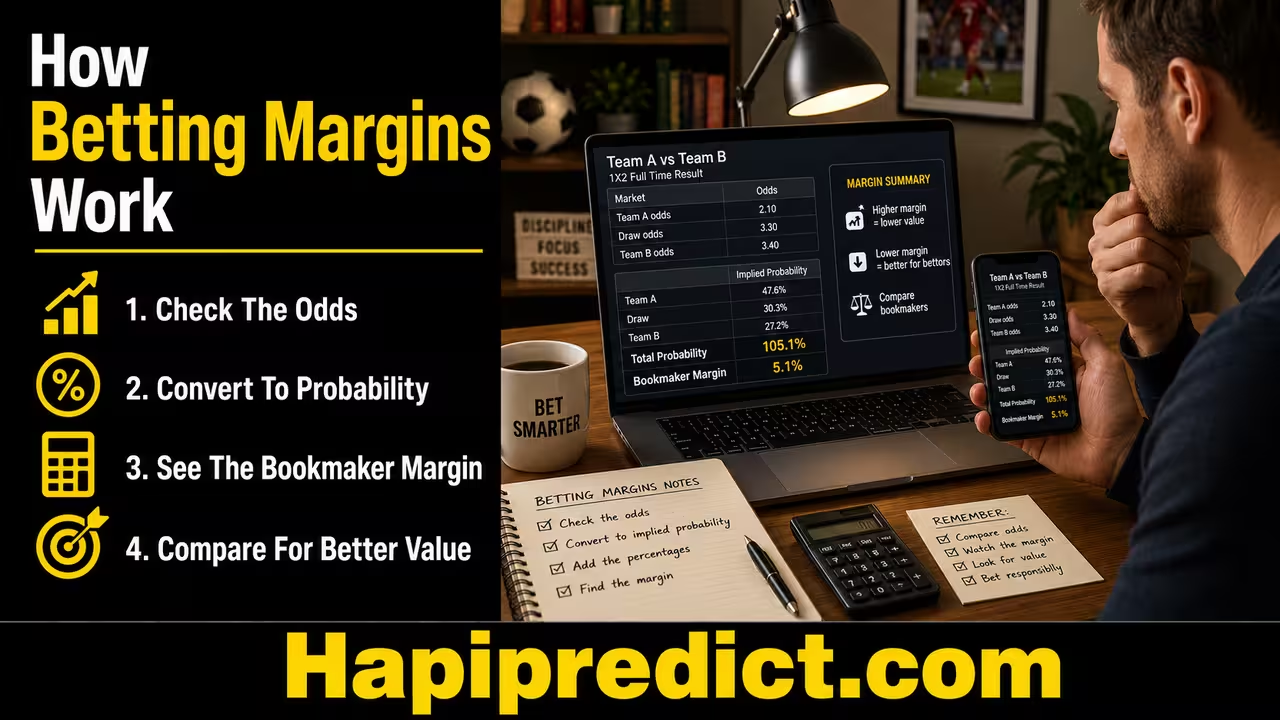
Betting margins are the built-in percentage bookmakers add to odds so the market is priced in their favor over time. They explain why betting odds usually pay less than the true probability of all possible outcomes.
Understanding betting margins helps you read odds more clearly, compare prices better, and know why bookmakers can still make money even when some bettors win. It does not make betting safe or guaranteed, but it helps you understand the hidden cost inside the odds.
What Is A Betting Margin?
A betting margin is the bookmaker’s built-in advantage in a betting market. It is the extra percentage included in the odds so the bookmaker has a better chance of making profit over many bets.
In a fair market with no margin, the implied probabilities of all outcomes would add up to 100%. In a bookmaker market, the implied probabilities usually add up to more than 100%. The amount above 100% is the betting margin.
For example, in a football match with three possible results, home win, draw, and away win, the true probabilities should add up to 100%. But the bookmaker may price the market so the implied probabilities add up to 106%. That extra 6% is the bookmaker’s margin.
This does not mean the bookmaker wins every bet. It means the market is designed so the bookmaker has a long-term pricing advantage across many customers and many bets.
Why Do Betting Margins Matter?
Betting margins matter because they affect how much value is built into the odds you are offered. A higher margin usually means the odds are less generous for bettors.
When a bookmaker adds margin, the odds become slightly lower than they would be in a fair market. This reduces the possible return for the bettor. The difference may look small on one bet, but it becomes important when many bets are placed over time.
For example, one bookmaker may offer 2.00 on a selection, while another offers 1.90 for the same market. The lower odds may include a higher margin or weaker price. If the selection wins, the bettor receives less return on the same stake.
Betting margins are one reason odds comparison matters. Two betting sites may offer different prices for the same outcome, and the one with a lower margin may give better odds to the bettor. However, better odds still do not guarantee a winning bet.
How Do Betting Margins Work?
Betting margins work by adjusting the odds so the total implied probability of the market is higher than 100%. This gives the bookmaker a built-in edge.
In a simple two-outcome market, a fair price might give both sides odds of 2.00 if each side has a 50% chance. But a bookmaker may offer 1.91 on both sides instead. At 1.91, each side has an implied probability of about 52.36%. Added together, the market becomes about 104.72%.
That extra percentage is the margin. The bookmaker is not saying both outcomes can happen at the same time. The bookmaker is pricing the market so the payout is lower than a perfectly fair market.
This margin helps the bookmaker manage risk, cover costs, and make profit over time. It is similar to a service charge built into the price of the market.
How Do You Calculate Betting Margin?
You calculate betting margin by converting each outcome’s odds into implied probability, adding the probabilities together, and subtracting 100%. The amount left is the bookmaker margin.
For decimal odds, the formula for implied probability is:
1 ÷ Decimal Odds × 100 = Implied Probability
For example, imagine a tennis match with two players:
Player A odds, 1.80
Player B odds, 2.10
Player A implied probability: 1 ÷ 1.80 × 100 = 55.56%
Player B implied probability: 1 ÷ 2.10 × 100 = 47.62%
Total implied probability: 55.56% + 47.62% = 103.18%
Bookmaker margin: 103.18% - 100% = 3.18%
This means the market has a margin of about 3.18%. The lower the margin, the closer the market is to a fair price. The higher the margin, the more expensive the market is for bettors.
What Is Implied Probability In Betting Margins?
Implied probability is the chance suggested by the odds. It helps you understand how odds translate into percentage terms.
For example, decimal odds of 2.00 imply a 50% chance because 1 divided by 2.00 equals 0.50. Decimal odds of 4.00 imply a 25% chance because 1 divided by 4.00 equals 0.25.
Implied probability is useful because betting margins are not always obvious when you look only at odds. A price may look normal, but when you convert every outcome into percentages, you can see whether the market adds up to more than 100%.
This is important in markets with many outcomes, such as correct score, horse racing, tournament winner, first goalscorer, or outright betting. The more outcomes a market has, the easier it is for a higher margin to be hidden inside the prices.
What Is Overround In Betting?
Overround is another name for the bookmaker’s margin. It refers to the total implied probability of all outcomes in a betting market when it adds up to more than 100%.
For example, if a market adds up to 106%, the overround is 106%. The margin is the extra part above 100%, which is 6%.
Some people use the words margin and overround as if they mean the same thing. Technically, the overround is the full total, while the margin is the amount above 100%. But in everyday betting discussion, both words are often used to describe the bookmaker’s built-in edge.
Overround is common in every normal bookmaker market. It is one of the main reasons bettors should compare odds instead of accepting the first price they see.
What Is Bookmaker Margin?
Bookmaker margin is the percentage advantage built into the odds by the bookmaker. It is how the bookmaker prices the market to protect itself and make profit over time.
The bookmaker does not need every selection to lose. Instead, the bookmaker aims to price markets so that, across many bets, the total money paid out is lower than the total money collected. The margin helps make that possible.
For example, if a bookmaker builds a 5% margin into a market, the odds are priced in a way that gives the bookmaker an edge. This does not mean every bettor loses instantly. It means the market is not priced at a perfect 100% fair probability.
Bookmaker margin is part of normal betting pricing. Bettors who understand it are less likely to think odds are neutral or perfectly fair.
Why Do Bookmakers Add Margins To Odds?
Bookmakers add margins to odds because they are running a business and need a built-in advantage to manage payouts, risk, operating costs, and profit. Without a margin, the bookmaker would have less protection.
Sports results are uncertain, and bookmakers can lose money on individual matches or markets. A popular underdog may win. A favorite may be heavily backed and win. A live market may move quickly. Margins help balance this uncertainty over time.
Margins also help bookmakers handle costs such as technology, data, staff, marketing, licensing, customer service, and payment processing. The margin is part of how the betting market is priced.
For bettors, the important point is that the odds are not just a pure reflection of probability. They also include the bookmaker’s business edge. That is why comparing odds and understanding margin can help you read prices more realistically.
How Do Betting Margins Affect Odds?
Betting margins affect odds by reducing the payout compared to a fair market. The higher the margin, the lower the odds usually become across the market.
For example, in a fair coin toss market, heads and tails would both be priced at 2.00 because each has a 50% chance. But if a bookmaker prices both at 1.91, the possible return is smaller. The difference is the margin.
On a ₦10,000 stake, odds of 2.00 would return ₦20,000 if the bet wins. Odds of 1.91 would return ₦19,100. The same type of outcome now pays less because the margin is included.
This effect is not always obvious because odds can look close. But small differences matter when comparing prices, especially on markets you bet on repeatedly.
What Is A Low-Margin Betting Market?
A low-margin betting market is a market where the bookmaker’s built-in edge is smaller. These markets usually offer more competitive odds.
Low-margin markets are often found in popular sports and major events because many bookmakers compete for customers. Big football matches, major tennis matches, top basketball games, and large racing events may have tighter margins than smaller or less popular markets.
A low-margin market is not risk-free. It only means the odds may be closer to fair pricing than a high-margin market. The selection can still lose.
For example, a major football match may have a margin around a few percent, while a smaller player prop or correct score market may carry a higher margin. The exact margin depends on the bookmaker and market.
Lower margin is generally better for the bettor because the odds are less heavily reduced by the bookmaker’s edge.
What Is A High-Margin Betting Market?
A high-margin betting market is a market where the bookmaker’s built-in edge is larger. These markets usually offer less generous odds to the bettor.
High margins are more common in markets with many possible outcomes or less certainty. Correct score, first goalscorer, horse racing, virtual betting, novelty markets, small leagues, and some player props can carry higher margins.
For example, a correct score market has many possible scorelines. The bookmaker may price each outcome with a margin included, and the total overround can become much higher than a simple match winner market.
High-margin markets can look attractive because they often include high odds. But high odds do not automatically mean good value. The market may still be expensive because the bookmaker’s edge is spread across many outcomes.
This is why bettors should be careful with markets that offer large payouts but have many conditions.
How Do Margins Work In Football Betting?
Margins in football betting are built into markets like match winner, over and under, both teams to score, handicap, correct score, and player markets. Some football markets have lower margins than others.
The main match result market usually has three outcomes: home win, draw, and away win. To find the margin, convert all three odds into implied probability, add them together, and subtract 100%.
For example:
Home win, 2.20
Draw, 3.40
Away win, 3.30
Home implied probability: 45.45%
Draw implied probability: 29.41%
Away implied probability: 30.30%
Total: 105.16%
Margin: 5.16%
This means the bookmaker has added about 5.16% over the fair 100% market. The same method can be used for over and under, both teams to score, and other football markets.
How Do Margins Work In Over And Under Markets?
Margins in over and under markets are usually easier to calculate because there are normally two outcomes: over and under. You convert both odds into implied probability, add them together, and subtract 100%.
For example, if over 2.5 goals is priced at 1.90 and under 2.5 goals is priced at 1.90, each side has an implied probability of 52.63%.
52.63% + 52.63% = 105.26%
The margin is 5.26%.
This does not mean both over and under can happen. It means the market is priced so the bookmaker has an edge. In a fair market with no margin, the combined implied probability would be 100%.
Over and under markets can be useful for learning margin because the calculation is simple and the number of outcomes is small.
How Do Margins Work In Horse Racing?
Margins in horse racing can be higher because races often have many runners. Each horse has odds, and the implied probabilities of all runners can add up well above 100%.
For example, in a race with ten horses, the bookmaker includes a margin across all ten prices. Even if one horse has high odds, the total market may still carry a strong bookmaker edge once every runner is included.
Horse racing margins can also change before the race. Odds may move because of betting activity, ground conditions, non-runners, jockey changes, trainer confidence, and market support. If a horse is withdrawn, the market may be adjusted.
This is why horse racing odds should be read carefully. A price may look big on one horse, but the overall market may still carry a high margin.
How Do Margins Work In Accumulators?
Margins in accumulators can multiply because each selection has its own built-in bookmaker edge. When several selections are combined, the total effect of the margin can become stronger.
An accumulator may show a large possible return, but each leg has already been priced with a margin. The more selections you add, the more conditions must win and the more pricing edges are combined.
For example, if you place a five-team accumulator, every team’s odds include the bookmaker’s margin. Even if each individual price looks close, the combined effect can make the ticket harder to land at fair value.
This is one reason long accumulators are risky. They do not only depend on many results going right. They also combine several priced markets into one bet.
How Can You Compare Betting Margins?
You can compare betting margins by calculating the implied probability of all outcomes across different bookmakers and seeing which market has the lower total percentage. The lower margin usually means better overall pricing.
For example, one bookmaker may price a tennis match like this:
Player A, 1.80
Player B, 2.10
Total implied probability, 103.18%
Another bookmaker may price the same match like this:
Player A, 1.75
Player B, 2.05
Total implied probability, 105.91%
The first bookmaker has a lower margin in this example. That means the overall market is closer to fair pricing. However, you should still check the specific selection you want, because one bookmaker may offer the better price on one side while another offers the better price on the other side.
Comparing margins helps you understand market quality, but it does not predict the result.
What Is Fair Odds In Betting?
Fair odds are odds that show the true probability of an outcome without bookmaker margin. They are sometimes called no-margin odds.
For example, if an outcome has a true 50% chance, fair decimal odds would be 2.00. If an outcome has a true 25% chance, fair decimal odds would be 4.00.
The formula is:
100 ÷ Probability Percentage = Fair Decimal Odds
So if you believe a team has a 40% chance of winning, fair odds would be 2.50 because 100 divided by 40 equals 2.50.
Fair odds are useful for understanding value, but true probability is difficult to know perfectly. Sports are uncertain, and different people may estimate chances differently. The main point is that bookmaker odds usually sit below fair odds because margin is included.
What Is Value Betting And How Does Margin Affect It?
Value betting means finding odds that may be higher than the real chance of the outcome suggests. Betting margin makes this harder because the bookmaker has already reduced prices to include an edge.
For example, if you believe a team has a 50% chance of winning, fair odds would be 2.00. If a bookmaker offers 2.20, that may look like value based on your estimate. If the bookmaker offers 1.80, the price may not be attractive because it pays below your estimated fair price.
However, value is not guaranteed. Your estimate can be wrong. Team news, injuries, weather, tactics, or unexpected events can change the outcome.
Betting margin means you must think carefully before calling any price valuable. A high price is not always value. It must be high compared with the realistic chance of the outcome.
What Are Common Mistakes With Betting Margins?
Common mistakes with betting margins include ignoring the bookmaker’s edge, choosing odds only because they look high, comparing different markets, and thinking low odds are always safe.
Many bettors look only at possible return and forget that odds are priced with margin. A market can look attractive but still be expensive. A correct score bet may offer big odds, but the market can carry a high margin and require a very specific outcome.
Common margin mistakes include:
Not understanding implied probability
Thinking odds are pure probability
Ignoring overround
Comparing different market types
Choosing high odds without checking risk
Betting on high-margin markets too often
Adding too many selections to accumulators
Treating low odds as guaranteed
Ignoring better prices elsewhere
Understanding margin helps you become more realistic about odds. It shows that betting prices are built with a bookmaker edge.
Is A Lower Betting Margin Always Better?
A lower betting margin is generally better for the bettor because the market is closer to fair pricing. However, it does not mean the bet is safe or that the selection will win.
A low-margin market can still lose because sports results are uncertain. A team can have good odds and still perform badly. A favorite can lose. A total can move the wrong way. A player can get injured.
Lower margin helps with pricing, not prediction. It is one part of understanding the market, not a guarantee of profit.
The best approach is to combine margin awareness with careful market reading, responsible staking, and realistic risk management.
How Can You Use Betting Margins Responsibly?
You can use betting margins responsibly by understanding that odds include a bookmaker edge, comparing prices carefully, keeping stakes small, and never treating any bet as guaranteed.
Responsible margin awareness includes:
Learn how implied probability works.
Compare the same market across platforms.
Avoid betting only because odds look big.
Be careful with high-margin markets.
Keep accumulators small or avoid them.
Use only money you can afford to lose.
Do not chase losses.
Stop if betting affects your mood or money.
Never bet with money meant for food, rent, school fees, savings, debt, transport, business, or family needs. If losing the stake would create stress, the bet should not be placed.
? Frequently Asked Questions
What Does Betting Margin Mean? ⌄
How Do You Calculate Betting Margin? ⌄
What Is Overround In Betting? ⌄
Why Do Bookmakers Use Margins? ⌄
Are Low-Margin Odds Better? ⌄
Do Accumulators Have Higher Margin Risk? ⌄
Related Articles
📬 Free Daily Predictions
Get expert picks delivered to your inbox every morning.